





Understanding the 5 Major Aspects in a Natal Chart
- What Is an Aspect in a Natal Chart?
- Major vs. Minor Aspects
- Hard Aspects vs. Soft Aspects
- The 5 Major Natal Aspects Explained
- Conjunction (0°)
- Sextile (60°)
- Square (90°)
- Trine (120°)
- Opposition (180°)
- Major Aspects at a Glance
- How to Read an Aspect: Orbs, Applying and Separating
- What Is an Orb?
- Applying vs. Separating Aspects
- Why Major Aspects Matter in Chart Interpretation
- Sources
Understanding the 5 Major Aspects in a Natal Chart
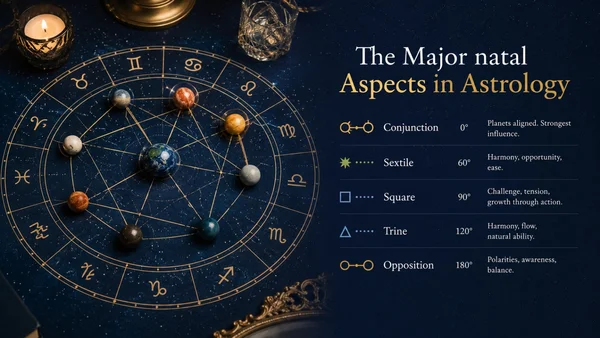
A natal aspect is the angular distance between two planets in your birth chart. It shows how those planets talk to each other. There are 5 major aspects: conjunction (0°), sextile (60°), square (90°), trine (120°), and opposition (180°). These five are also called the Ptolemaic aspects. They are named after the astronomer Ptolemy who first mapped them out.
Each aspect tells a different story. A conjunction blends planetary energies into one force. A sextile opens up an easy chance to grow. A square creates friction that pushes you to act. A trine lets energy flow with little effort. An opposition pulls two parts of you in different directions. It asks you to find balance.
This article looks only at natal aspects. These are fixed at your birth moment. It does not cover transits or synastry. Those methods compare charts between two different times or two different people.
Keep reading to learn how orbs, applying aspects, and separating aspects change the strength of each connection in your zodiac sign placements.
What Is an Aspect in a Natal Chart?
A planetary aspect is the angle between two planets on the day you were born. Astrologers measure it along the 360° zodiac circle as seen from Earth. Your birth chart freezes these angles at the exact minute of your birth. A natal aspect stays fixed for life. This differs from transiting or synastry aspects, which shift as planets keep moving.
Major vs. Minor Aspects
The 5 major aspects are conjunction, sextile, square, trine, and opposition. They use round numbers: 0°, 60°, 90°, 120°, and 180°. These are also called Ptolemaic aspects. Ptolemy wrote about them almost 2,000 years ago. Minor aspects use smaller, less obvious angles like the semi-sextile or quincunx. This article focuses on the major five. They carry the strongest weight in any aspect pattern.
Hard Aspects vs. Soft Aspects
Astrologers group aspects by how they feel. Soft, harmonious aspects include the sextile and trine. They let energy move with ease. Hard, dynamic aspects include the square and opposition. They create tension and push you toward action. The conjunction sits outside both groups. It is neutral by nature. Its effect depends on which planets are involved and their zodiac sign placement.
The 5 Major Natal Aspects Explained
These five aspects are also called Ptolemaic aspects. Each one has its own degree, orb, and logic based on element and modality.
Conjunction (0°)
Two planets sit at the same point, give or take an 8-10° orb. They fuse and act as one combined force. Sun conjunct Mercury sharpens focus and communication. It can sometimes tip into self-centered thinking. The traits blend for better or worse.
Sextile (60°)
Planets sit 60° apart in compatible elements like fire and air. This aspect offers opportunity. It needs your initiative to activate. Venus sextile Mars gives natural charm and drive if you use it. The orb runs around 4-6°.
Square (90°)
Planets sit 90° apart in the same modality but different elements. This friction pushes growth through tension. Sun, Mercury, and Venus can never square each other in a natal chart. Mercury stays within 28° of the Sun. Venus stays within 48° of the Sun. A 90° angle between them is impossible.
Trine (120°)
Planets in the same element form a trine. This creates effortless flow with a 6-8° orb. Jupiter trine Neptune brings easy imagination and optimism. It can sometimes breed complacency. Sun, Mercury, and Venus never form a trine to each other for the same orbital reasons as the square.
Opposition (180°)
Two planets face each other across the zodiac sign wheel. This polarity demands balance. You often find this balance through relationships. Moon opposite Saturn shows emotional needs clashing with duty or fear. It is a common aspect pattern in synastry too.
Major Aspects at a Glance
This table shows all 5 major aspects side by side. These are the classic Ptolemaic aspects. Save this table to check any planetary aspect in your own birth chart.
| Aspect | Symbol | Degree | Typical orb | Element/modality link | Nature | Core keyword |
|---|---|---|---|---|---|---|
| Conjunction | ☌ | 0° | 8-10° | Same sign | Neutral | Fusion |
| Sextile | ⚹ | 60° | 4-6° | Compatible elements | Soft | Opportunity |
| Square | □ | 90° | 6-8° | Same modality | Hard | Tension |
| Trine | △ | 120° | 6-8° | Same element | Soft | Flow |
| Opposition | ☍ | 180° | 8-10° | Same modality, opposite sign | Hard | Balance |
Orbs are not fixed rules. Many astrologers widen them to 10° for the Sun or Moon. These lights carry more weight in a natal chart. A tight 1° orb feels stronger than one sitting near the edge of its range.
This table only covers major aspects. Minor aspects use smaller orbs and add finer detail once you know the basics. Check if an aspect is applying or separating. This changes how it plays out over time within an aspect pattern.
How to Read an Aspect: Orbs, Applying and Separating
What Is an Orb?
An orb is the margin of error allowed before an aspect counts as exact. A perfect conjunction is 0°. Real charts rarely land that clean. Astrologers who work with Ptolemaic aspects usually accept a wider orb for the Sun and Moon. They allow up to 8-10° because these two carry more weight. Minor aspects get a tighter orb of 1-2°.
Use this method to calculate. Take the zodiac degree of each planet and subtract one from the other. Venus at 14° Aquarius and Mars at 12° Aquarius create a 2° orb. This reads as a tight, strong conjunction. If Mars were at 6° Aquarius, the orb would stretch to 8°. It is still a conjunction, but it is much weaker in practice.
Applying vs. Separating Aspects
Check which planet moves faster. If the faster planet is heading toward the exact angle, the aspect is applying. That energy is still building. You will feel it unfolding over time. If the faster planet has already passed the exact point, the aspect is separating. That energy already peaked. It is like a lesson you have already absorbed.
A wide orb can push an aspect out-of-sign. This means the planets sit in signs that do not naturally match the aspect pattern. That weakens or complicates the reading. Treat it as a footnote rather than a full-strength placement.
Why Major Aspects Matter in Chart Interpretation
A square is not a bad omen. It marks friction. Friction pushes you to act, adapt, and grow. A trine is not free luck. Ease can sit there unused if you never test it. Hard aspects like squares and oppositions show pressure points that build character. Soft aspects like sextiles and trines show natural flow. Flow only helps if you actually use it.
Sometimes several planets link up through the same pattern. Planets connected by squares and oppositions can form a tense shape like a T-square. Several planets joined by trines can form a grand trine. These aspect patterns go beyond a single planetary aspect. Most astrologers study them only after they understand the basics.
Natal aspects are fixed the moment you are born. They describe personality traits that stay part of you. Transits measure how moving planets touch those same natal points today. They time events and phases. Synastry compares two birth charts to read compatibility. Both techniques build on your natal aspects as the base layer.
Aspects describe tendencies rather than fixed fate. Treat your chart as a tool for self-reflection. Talk to a qualified professional for major life, health, or money decisions.